

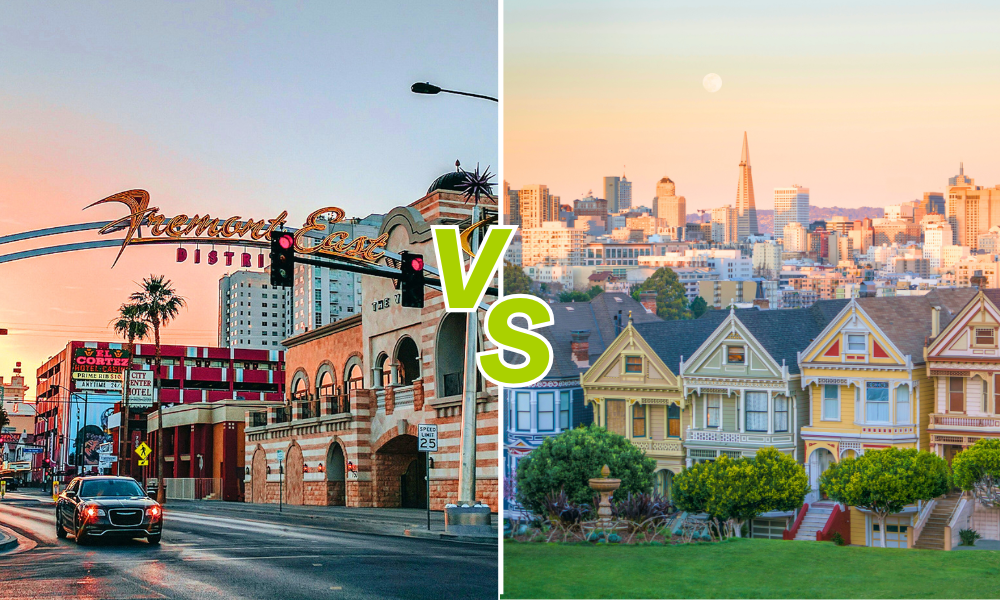

You already know the Bay Area market is wild, with bidding wars, cash buyers, 10-day closes, and properties that barely hit the MLS before disappearing. But when you start house-hunting in Las Vegas, the rules shift. The pace slows a little, the prices drop a lot, and the process has its own quirks to know.
Whether you’re a Bay transplant or a born-and-raised Californian ready to invest in your desert era, here’s what to expect when you go from buying in the Bay to buying in Vegas.
The Price Tag Reality Check
In the SF Bay Area, median home prices still hover around $1.3M and even a fixer-uppers in a less than stellar neighborhood can cause bidding wars. Enter Las Vegas. Here, the median single-family home price is closer to $450K. And with that smaller number often comes square footage, a yard, and even a pool. For many Bay Area buyers, it’s surreal to realize that what used to buy a condo can now buy a whole desert lifestyle.
The first time I ran a Vegas home search, I genuinely thought the prices were wrong. Did the listing agent leave a zero off? But in reality, you can expect anything updated and priced under $500K to move fast, especially in extra desirable neighborhoods like Summerlin, Green Valley, or the Southwest.
Get pre-approved early and be ready to write the offer. Homes here may be cheaper, but they don’t wait around.
Don’t Expect a Disclosure Packet Up Front
In the Bay, you’re used to getting thick disclosure packets before you even think about writing an offer. Every detail, from the roof’s age to the sewer lateral report, is laid out upfront so you can decide how aggressive you want to go. In Vegas, it flips. You don’t receive all that information by default before making an offer. Instead, once your offer is accepted, you enter a due diligence period where you order your own inspections.
It’s a shift that surprises a lot of Bay buyers, and again, it speaks to the more relaxed pace of the Vegas real estate market. You get about 7–10 days to hire your inspectors, review the reports, and decide if you’re comfortable moving forward. My first Vegas inspection took half the time I expected, and half the stress, and it really made me realize how much more buyer-driven the process is here.
HOA Life is Your New Norm
In Vegas, HOAs are as common as palm trees. Even modest developments or starter neighborhoods have small dues that cover landscaping, security patrols and community maintenance. In return, you get clean streets, uniform curb appeal, and fewer neglected properties, something I promise that you will start to appreciate once you see how fast desert landscaping can dry out.
Coming from the Bay, we’re used to side-eyeing homes that come with an HOAs and thinking of them as restrictive, but here they really do make sense. They’re the reason entire neighborhoods still look polished even through 115° heat. Before you fall in love with a house, always factor the HOA fee into your monthly costs. A “deal” can shrink fast if you’re adding $200+ in dues each month.


New Construction Is Everywhere
Vegas is still growing, which means new-build communities stretch in every direction. You’ll see sleek, energy-efficient homes with open layouts, smart features, and desert-friendly landscaping. Compared to the Bay Area’s decades-old housing stock, it feels like stepping into a model home dream, as long as that your kind of thing. I still remember walking into one and smelling that fresh paint with Red Rock views in the window, wondering why I ever tolerated Bay plumbing from 1952.
Another bonus is that Builders often offer incentives to entice buyers to choose a one of their new homes, from rate buydowns to closing costs being covered. But remember: the sales rep are not the same as a Buyer’s Agent, and they work for the builder, not you.
Always bring your own agent to a new-build site so you have someone protecting your interests during negotiations and walkthroughs.
Property Taxes Flip the Script
Property taxes look slightly higher in Nevada on paper, hovering at roughly 1.05–1.25% compared to the Bay’s average 1%. But since Vegas home prices are dramatically lower, your actual bill will likely be thousands less. You’ll also of course avoid California’s state income tax altogether, which frees up more for upgrades or savings.
Nevada’s tax structure is designed to stay predictable, with annual increases capped around 3% for primary homes. That means you can budget a bit more confidently instead of bracing for surprise reassessments like in California. Even when your home value rises, your tax bill won’t skyrocket alongside it. For me, that kind of stability felt like a small luxury, one of those quiet, perks that makes desert life even sweeter.
Commutes and Lifestyle Priorities Shift
Bay buyers are used to factoring in BART stations, bridge tolls, and carpool lanes. In Vegas, your main consideration is proximity to the 215, 95, or 15, and how the desert sun affects your daily rhythm. A 20-minute drive here actually means 20 minutes, not 90 depending on traffic and luck. And unlike the Bay, public transportation isn’t really part of the equation. This is a driving city through and through.
Housing prices aside, you might choose Summerlin for the proximity to Red Rock and those mountain views that never get old, or Green Valley in Henderson for its family-friendly parks, trails, and easy access to local shops and dining. Another surprisingly big factor? The direction your home faces. In the desert, east- and west-facing homes take the brunt of the sun, meaning your windows and AC bill will feel it all summer long, North- and south-facing homes tend to stay noticeably cooler. Lifestyle planning takes priority over pure commute time.
Visit neighborhoods at sunset — you’ll get a real sense of the light, sound, and pace that’ll define your day-to-day life.

If you’re thinking about making the jump, start with curiosity. Talk to a local lender, explore neighborhoods, and run the numbers — but also, trust how it feels. Vegas might surprise you in all the right ways.
Ready to find out which Vegas neighborhood fits your Bay vibe? Send me a message or start with my neighborhood deep dive, from Summerlin’s mountain views to Green Valley’s easy suburban flow, you’ll see how desert living really stacks up.